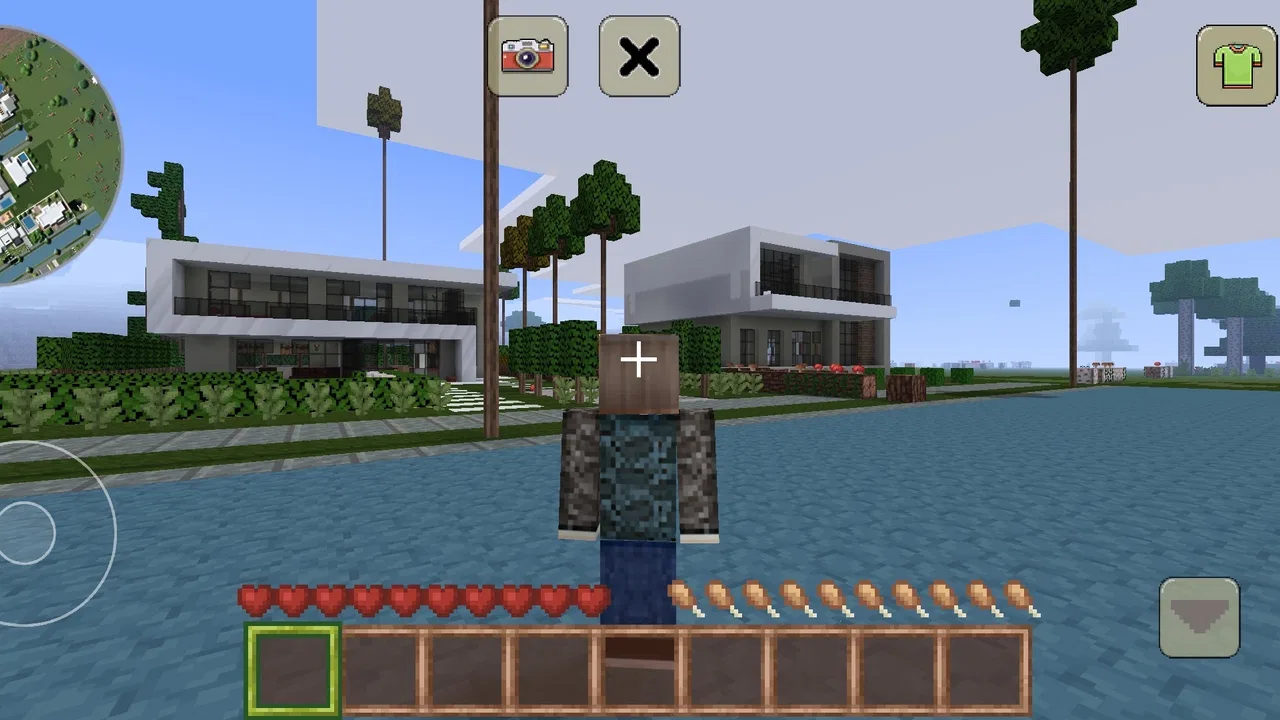
MiniCraft Pocket Edition Game
- 3.7
- Rating
- 1.00M
- Installs
- Free
- Price

 Analysis by App-foxy
I approached MiniCraft Pocket Edition Game as a lightweight-looking mobile building experience, but its real appeal is less about presentation and more about how quickly it lets you move from an empty space to something you have made yourself. It is an Android app in the Events category, developed by Loco Craftman Studio, and it is free to use. The central idea is simple: blocks, tools, and inventory items are available so you can start building without first working through a long introduction.
That immediacy makes it easy to understand. I did not need to study a complicated interface before trying the basic building loop. Pick an item, place it, change the shape of the environment, and continue experimenting. For someone who wants a pocket-sized creative sandbox rather than a highly structured campaign, that straightforward approach is the strongest reason to try it.
How the experience feels during ordinary play
The first thing I noticed was the low barrier to entry. The app is aimed at users aged Teen, but its block-based concept is familiar enough that a player who already understands mobile construction games can get moving quickly. The inventory focus also changes the rhythm: instead of treating every material as a rare discovery, the app encourages you to think about what you want to make and then choose the pieces needed for that idea.
You May Also Like

 Pandora - Music & Podcasts
Pandora’s Music Is Easy to Start, but Harder to Recover
Pandora’s strength is its low-effort path from a seed to a station. Its weak spot is how much confidence it asks you to place in connection, setup, and quiet recovery.

 8 Ball Pool
 Is Built on Rivalries, Rematches, and Routine
A close look at the rivalries, rematches, shared routines, and unanswered safety questions that turn a quick pool match into a persistent mobile community.

 Samsung Music
’s Quiet Strength Is Playing What You Already Own
Its reach comes less from spectacle than from dependable access to a personal library. That simplicity is both the app’s strongest retention engine and its ceiling.

 AccuWeather: Weather Radar
AccuWeather Review: A Quick, Clear Forecast for Everyday Decisions
For everyday plans, the best forecast is the one you can understand quickly. AccuWeather makes rain timing, radar, and local conditions easy to act on, with a few trade-offs.

 Hill Climb Racing
Why Hill Climb Racing Still Turns Crashes Into One More Run
A tiny car, a bumpy hill and one more upgrade: Hill Climb Racing keeps resurfacing because its simple chaos makes every near-miss feel personal.

 AliExpress - Shopping App
AliExpress Makes Global Shopping Feel Personal, but Shoppers Bear the Risk
AliExpress turns a global marketplace into a pocket-sized discovery engine. Its reach is useful, its shopping loop compelling, and its trade-offs easy to miss.
More From Our News Desk
View All News


That can be especially useful when you have a short break and do not want to commit to a long session. I can imagine opening it while waiting for an appointment, sketching the outline of a small house, testing a layout, and closing the app once the basic shape feels right. It is not necessary to approach every session as a major project. The format works well for quick experiments, visual planning, and casual building.
Speed expectations should remain realistic. I found the basic interaction easy to start, but the perceived pace depends on how much you place and how carefully you edit. A small construction feels immediate because each action has a visible result. A larger scene naturally demands more attention, more camera movement, and more repeated inventory choices. That is not a flaw unique to this app, but it matters if you expect a smooth, effortless experience while creating something extensive.
The current version is 138.33.21.19, and the app requires Android 8.0 or later. Those details make it more suitable for relatively recent phones and tablets than for older devices kept on earlier software. If your device satisfies the operating-system requirement, the next practical question is not simply whether it can open the app, but whether it remains comfortable when your build becomes crowded.
Starting a build without wasting time
My preferred way to use this kind of app is to begin with a small plan rather than immediately covering a large area. I choose one purpose for the first section, such as a compact room, a path, or a simple exterior wall, and then keep the early inventory choices focused. This avoids spending the first few minutes switching between unrelated items and gives the build a recognizable shape quickly.
A useful, less obvious habit is to treat the first few placements as a test rather than as permanent work. I check how comfortable the camera movement feels, whether selecting and placing blocks matches my thumb position, and whether I can correct an accidental placement without losing the layout. Doing this at the beginning is better than discovering control friction after investing time in a detailed structure.
The inventory-centered design is also helpful for visual comparison. I can try two materials beside each other, decide which combination looks better, and then repeat the chosen pattern. That makes the app useful for rough design ideas, even when I am not trying to complete a polished world. It is closer to a hands-on sketchbook than to a strict task manager.
However, the same openness can feel limited for players who need clear objectives. If you want missions, a strong narrative, or a carefully guided progression path, the app may not provide the motivation you are looking for. I would choose it for self-directed construction, not for a sequence of challenges that constantly tells me what to do next.
What happens during heavier building sessions
The most demanding moments are likely to come from scale and density rather than from the first few blocks. A tiny structure gives the device relatively little to display and gives the player fewer camera adjustments to make. A broad area filled with many different elements creates a busier visual scene and requires more repeated interaction. In those moments, the experience can feel less immediate simply because there is more on screen and more to manage.
I recommend dividing ambitious projects into sections. I might finish the ground layout first, then work on the walls, and only afterward add decorative details. This workflow has two advantages: it keeps the project mentally manageable, and it gives me natural stopping points if the phone begins to feel warm or the controls become less responsive. It also makes recovery easier because I know exactly which part of the design I was working on.
Another practical tip is to avoid making every area equally complicated. A large build does not need dense decoration everywhere to look interesting. Leaving open space around a central structure can make the result clearer while reducing unnecessary editing. This is a creative choice, but it also acts as a sensible performance trade-off when using a phone with modest hardware.
For short sessions, I would avoid starting with a huge landscape or a highly detailed settlement. Beginning with a repeatable pattern, such as a small row of buildings or a simple courtyard, lets me judge how the app behaves before I commit to a more ambitious design. If the device handles that comfortably, I can expand gradually instead of discovering the practical limit all at once.
Players should also consider their own control habits. Fast placement is convenient, but rushed taps can create unwanted changes that then take longer to repair. I get better results when I slow down for corners, entrances, and narrow spaces, while using quicker movements only for broad, repetitive sections. That balance makes the experience feel more controlled and reduces the frustration of correcting avoidable mistakes.
Stability, interruptions, and getting back to a project
Reliability is not only about whether an app opens. For a building game, it also means whether I can return to a project without feeling lost, whether my recent work remains usable, and whether the controls continue to behave consistently during a longer session. MiniCraft Pocket Edition Game is most comfortable when I treat it as a series of manageable creative visits rather than one uninterrupted construction marathon.
Before making a major change, I prefer to pause and look at the whole area. This simple habit helps me remember the current layout and makes it easier to resume later. I also avoid closing the app immediately after a large burst of edits; giving myself a moment to check the result is a sensible recovery habit for any mobile creative tool. It reduces the chance that I leave the project in a confusing half-finished state.
Recovery matters particularly on a phone used for many other tasks. A call, message, low-battery warning, or switch to another app can break concentration. Because of that, I suggest ending a session at a clear milestone: complete a wall, finish a room, or place the main entrance. When I return, I can identify the next action immediately instead of trying to reconstruct my intentions from scattered changes.
I would not describe the app as a substitute for a carefully managed desktop creative environment. A phone is more vulnerable to interruptions, limited screen space, and touch-control mistakes. Those constraints do not prevent enjoyable play, but they change how I judge reliability. The app works best when I adapt the project to mobile use instead of expecting the same comfort as a larger platform.
The public response gives the app a 3.7 average from around 7.8 thousand ratings, with 47 written reviews. I read that as a sign of a mixed but substantial user base rather than a universal recommendation. The install count is over one million, so it has clearly reached a large audience, yet popularity alone does not guarantee that every device or play style will feel equally comfortable.
Device limits and practical expectations
The Android 8.0 minimum is important for compatibility, but it does not tell me how every supported phone will perform. Devices differ in memory, processor strength, display size, and the number of background tasks running at the same time. A newer phone with more headroom should offer a more comfortable experience during larger builds, while an older supported model may be better suited to smaller scenes and shorter sessions.
If I were installing it on a device with limited storage or several demanding apps already open, I would first close unnecessary background activity and leave room for the app to work comfortably. I would also avoid judging it from a single crowded project. A small test build is a fairer way to see whether the controls, camera, and general responsiveness suit that particular phone.
Screen size affects the experience more than many people expect. On a compact phone, precise placement can feel cramped, especially around corners or narrow openings. A larger display gives me more space to inspect the build and reduces the need for constant camera correction. This is one reason I would recommend a tablet or larger phone for someone planning detailed structures, while a smaller device remains fine for quick sketches and basic layouts.
Battery behavior is another everyday consideration. I would not begin a long building session with a nearly empty battery, especially if the phone is already warm from other activity. The app is free, which makes trying it easy, but free installation does not remove the practical limits of the hardware. A comfortable experience depends on matching the size of the project to the device rather than assuming every supported phone will handle the same workload identically.
There is also a difference between technical capability and personal patience. Even if a phone can display a larger scene, touch controls may still make detailed editing tiring after a while. I find that alternating between construction and a quick visual review helps. It prevents me from repeatedly zooming into the same area and gives my hands a break from identical placement gestures.
Who will get the most from it
I think this app suits players who enjoy creating their own goals. It is a good match for someone who wants to test building ideas, make simple environments, or spend a few minutes arranging blocks without paying an entry fee. It can also work for families or friends who want to compare small creations, provided the Teen content rating fits the people using the device.
It is especially appealing if you like starting with a blank space and deciding the direction yourself. I enjoy that kind of freedom because the same inventory can support very different projects: a practical shelter, a decorative scene, a compact maze-like layout, or a rough plan for a larger idea. The value comes from experimentation rather than from being rewarded for following a fixed route.
I would advise skipping it if your priority is a deep story, competitive multiplayer, highly polished presentation, or a large collection of structured objectives. I would also look elsewhere if you dislike touch-based building and want precise mouse-and-keyboard control. The app’s strengths are immediacy and creative access, not the feeling of using a full desktop editor.
Compared with the usual alternatives in the block-building category, this one feels more focused on getting materials and tools into the player’s hands quickly. A more survival-oriented alternative may offer greater tension through scarcity and progression, while a more established creative platform may provide broader systems, richer customization, or a more refined interface. MiniCraft Pocket Edition Game is attractive when I want the simpler middle ground: open-ended construction without turning every session into a demanding project.
Small workflows that improve the experience
My first recommended workflow is the “outline before detail” method. I place the perimeter of a structure with one consistent material, inspect the proportions from several angles, and only then add windows, doors, or decoration. This prevents me from spending time on attractive details attached to a building that is too narrow, too wide, or awkwardly positioned.
The second is to use repeated sections as checkpoints. If I am building a wall, I complete a short segment and compare it with the intended pattern before extending it across the whole project. This catches spacing mistakes early. On a touch screen, correcting one short segment is much less frustrating than rebuilding an entire side after noticing that the pattern drifted.
The third is to keep a “safe test area” near the main build. I use it to compare materials, try an arrangement, or decide whether a decorative idea works before applying it to the finished structure. This turns the inventory into a practical design palette and protects the main project from impulsive experiments.
Finally, I recommend ending each session with a simple visual landmark. It might be a completed entrance, a distinct corner, or a finished roof section. That landmark helps me resume quickly and gives the project a sense of progress even when I only have a few minutes to play. It is a small habit, but it makes an open-ended app feel more organized.
My performance verdict
MiniCraft Pocket Edition Game works best when I judge it as a flexible mobile building tool rather than as a complete replacement for every larger block-based game. Its free price, accessible inventory approach, and quick start make it easy to recommend to curious Android users who want casual creative play. The one-million-plus install reach also shows that the concept has found a sizable audience.
My main reservation is that the experience depends heavily on the device and the scale of the project. Small builds should be the safest starting point, while large, crowded scenes require more patience and a sensible workflow. I would not promise identical smoothness across every supported phone, and I would avoid treating the Android requirement as a guarantee of equal performance on all hardware.
For me, the best use is a short, self-directed session: sketch a structure, test a material combination, complete one section, and return later. That approach keeps the controls manageable and makes recovery from interruptions straightforward. If you want guided progression or sophisticated long-form creation, a different option may be a better investment of your time.
Overall, I see this Events app from Loco Craftman Studio as a practical choice for players who value immediate block placement and personal creativity more than elaborate systems. Its strongest quality is the freedom to begin building quickly, while its biggest trade-off is the need to adapt project size and session length to your device. With realistic expectations and a section-by-section workflow, it can be an enjoyable pocket sandbox rather than an overambitious replacement for every alternative.
FAQs for MiniCraft Pocket Edition Game
01What is MiniCraft Pocket Edition?
MiniCraft Pocket Edition is a mobile game that allows players to explore, build, and survive in a blocky, pixelated world. It offers creative and survival modes, where you can either unleash your creativity with unlimited resources or face challenges by gathering materials and battling creatures.
02Is MiniCraft Pocket Edition free to download?
The basic version of MiniCraft Pocket Edition is available for free on both Android and iOS platforms. However, it may include in-app purchases or ads that enhance gameplay or remove ads. Always check the app store for the latest pricing and feature updates.
03What are the system requirements for MiniCraft Pocket Edition?
MiniCraft Pocket Edition requires a device running Android 4.4 or later, or iOS 9.0 or later. It's advisable to have at least 100 MB of free storage space for installation and smooth gameplay. A stable internet connection is recommended for multiplayer features.
04Does MiniCraft Pocket Edition support multiplayer mode?
Yes, MiniCraft Pocket Edition supports multiplayer mode, allowing you to connect and play with friends online. You can collaborate on building projects or compete in survival challenges. Ensure you have a stable internet connection to enjoy seamless multiplayer experiences.
05Can I play MiniCraft Pocket Edition offline?
MiniCraft Pocket Edition can be played offline in single-player mode, making it great for gaming on the go without internet access. However, features such as multiplayer and updates require an internet connection. Offline mode is ideal for uninterrupted creative or survival gameplay.
Pros
- Engaging and creative gameplay.
- Simple and intuitive controls.
- Frequent updates with new content.
- Offline mode available.
- Highly customizable worlds.
Cons
- Graphics are somewhat basic.
- Limited multiplayer options.
- Occasional in-game ads.
- Battery consumption can be high.
- Some features behind paywall.

MiniCraft Pocket Edition Game
Gallery